

The difference between a screen people act on and one they've learned to ignore
A screen on a wall earns nothing by being a screen. It earns its keep when it shows the right thing, in the right place, at the moment someone is close enough to act on it. That is where digital signage becomes a commercial asset rather than a fixture.
In a shop, it can tip a decision while the customer is still holding the alternative. In a hotel, it can put a spa treatment or a late checkout in front of a guest at the exact point that choice feels natural. In a stadium, it can move crowds, sell food and drink, and give sponsors somewhere to be seen where attention has already gathered. In a coworking floor, a residential lobby, a leisure venue or a hospital, it can keep services and opportunities visible without a member of staff repeating the same message all day.
The strongest signage doesn’t just fill a wall. It makes the building responsive. A printed poster says one thing until someone climbs up and changes it. A managed network moves with the rhythm of the place: breakfast at eight, meeting-room availability at noon, spa slots in the afternoon, the event upgrade at six, and wayfinding the moment a crowd starts to move.
That flexibility is the point, because revenue is never created by the screen. It is created by relevance, timing, placement and control. Left to drift, signage becomes background noise. Handled well, it becomes a managed channel inside the spaces where decisions are already being made.
The value of the moment
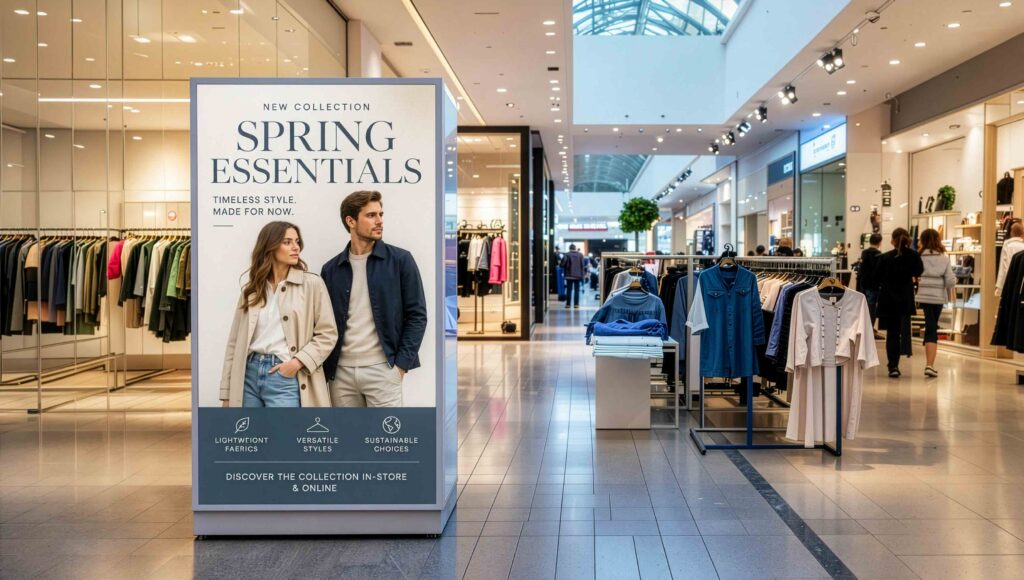
Retail makes the case most plainly, because the distance between message and purchase is shortest. A customer standing in front of a product is not in the frame of mind of someone half-watching an advert at home. They are present. They are already weighing it up. Often they don’t need persuading from a standing start — only a nudge, a comparison, a reason to choose now.
Field research in the Journal of Marketing studied 237 in-store signage campaigns across roughly 30 million shoppers. It found that screens lifted the likelihood of buying the featured product by 8.1%, and that the effect grew stronger the closer the screen sat to the product itself.
That is not an engagement statistic. It is an instruction: screens work harder near decisions. Put a display by the till, the window, the end of the aisle, or beside the high-margin line a customer would otherwise walk straight past. The same logic travels well beyond retail — food and drink offers where stadium crowds head for the concourse, a class or membership where a leisure visitor is most engaged, a restaurant booking surfaced in a hotel lift. Different rooms, one rule. A message is worth more at the point of decision.

Selling without cheapening the space
There is a catch. Signage earns revenue only when it respects the room it stands in. A hotel lobby that feels like a discount aisle has already lost. A residential lounge is not a shopping centre. A hospital waiting area is not advertising space to be auctioned off. Even in retail, where selling is the whole job, too much noise becomes wallpaper.
The better instinct is restraint. In hospitality, the signage that sells best is the signage that reads as service: tonight’s event, a free table, a spa slot, the last airport transfer. The message is commercial and useful at the same time, which is exactly why it works.
The principle holds across sectors, with the volume turned to suit each one. In coworking spaces, the same screens can surface a free meeting room, a member event or a day pass without turning the community team into a sales floor. In build-to-rent, they can point residents to the gym timetable, the cinema room or the private dining space — gently, because people are at home. In healthcare the line is finer still: a café, a pharmacy message, a fundraising campaign, a follow-up pathway, always sitting behind the care rather than in front of it.
Good signage knows what room it’s in.
A smart TV platform ensures that investment delivers real value, day after day, stay after stay.
The hidden revenue: fewer missed opportunities
Not every return shows up as a sale. Some of it is simply waste recovered — the quiet losses a building runs up every day. The restaurant has a free table and nobody knows. The meeting room sits empty because members assume it’s booked. The gym class has space the residents never see. The shop has a high-margin line the customer’s eye slides past.
These aren’t disasters. They’re missed moments, and they add up. Signage recovers them by doing one plain thing: making the available thing visible — the open table, the empty room, the faster route, the upgrade that makes sense, the campaign that needed to be seen today rather than next week.
Which is why signage belongs in the conversation about how a building actually performs, not only how it markets itself. It coordinates movement, visibility and demand across a physical space.
Retail media, closer to the ground
There is a bigger shift behind all of this. Retail media — advertising placed where buying actually happens — has become one of the most closely watched channels in the industry. Nielsen expects investment in it to keep climbing, with marketers steadily moving more of their budgets towards it.
The reason is something digital platforms spend fortunes trying to manufacture: proximity to intent. A screen in a store, a hotel, a venue or a coworking building isn’t floating in borrowed attention. It is fixed to a place, a context and a likely next action. That is what gives it worth.
For a retailer, that becomes supplier-funded advertising. For a venue, sponsorship. For a hotel, a well-chosen local partner. The aim is never to paper every screen with adverts — the quickest way to teach people to ignore them — but to build a small, relevant inventory that suits the audience and the setting.
The system matters more than the screen
This is where signage projects quietly succeed or fail. The screen is the visible part. The system behind it is not — and the system is what decides whether the screen is worth having.
Can you change the content in minutes? Can different screens carry different messages? Can a campaign be scheduled by time, place or audience, and managed from anywhere? Is the network reliable? Is the display right for its environment, readable at the distance people actually stand, positioned where eyes naturally land? And once the installer has gone, is it clear who owns the content? Answer those well and signage becomes infrastructure. Answer them badly and it stays decoration.
This is the layer airwave connect works in. It doesn’t just supply screens. It designs, installs and supports the whole environment around them — displays, media systems, networks, content management, remote support and the wider AV setting signage usually sits within. That breadth matters because the requirements are rarely the same twice. A shop needs signage that shifts buying behaviour. A hotel needs messaging that lifts spend without denting the experience. A coworking floor needs screens that speak clearly and quietly. A stadium needs systems that hold up under pressure and at scale. A home needs a tone that suits where people live. A hospital needs sensitivity as much as reliability.
Screens may look similar from a distance. The environments behind them are not.
A commercial asset, not a modern decoration
The weakest argument for digital signage is that it looks modern — and it’s the least interesting one too. The real case is that it hands an organisation a managed channel inside the spaces it already owns or runs: a way to speak to people where they are present, paying attention and able to act.
Done well, it sells products, fills amenities, supports sponsorship, promotes partners, recovers missed opportunities and makes existing space work harder. Done badly, it’s one more screen people have learned not to see.
The difference isn’t the hardware. It’s strategy, placement, content and support. Signage can generate real revenue — but never by accident. Design it around how people behave, not around the wall you happened to have spare. That is how a screen earns its place.
Comment here
Name, Title, Company
Grey text box for paragraphs.
Get in touch
We're passionate about hospitality technology, proud of the work we do and would love to share our enthusiasm with you! Please feel free to get in touch to discuss our portfolio of products and services:
connect@airwaveconnect.co.uk or +44 (0)1403 783 483