
WIFI & NETWORKS
Common Wi-Fi & Network Requirements
- Guest Wi-Fi with branded login, tiered access and usage management
- High-density coverage planned around peak occupancy, not average use
- Staff and operational networks kept separate from guest traffic
- Wired infrastructure for POS, back-of-house systems and connected devices
- Network management and monitoring via a centralised cloud dashboard
- Resilient connectivity with failover to keep critical systems online
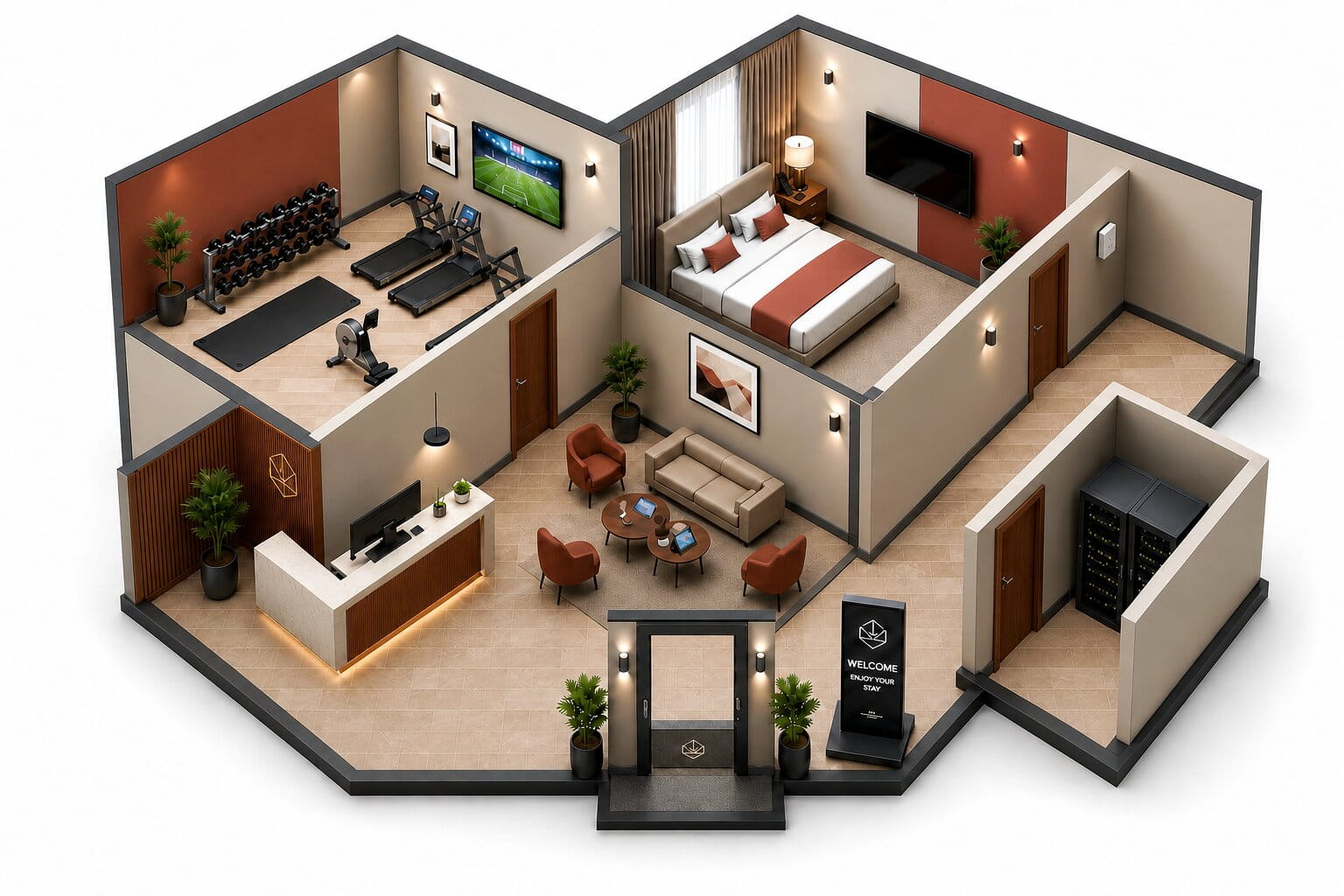
Most Wi-Fi struggles not because of poor signal, but because of too many devices competing for the same capacity. High-density design plans access point placement, channel allocation, and client load around how a space is actually used — at peak, not at quiet.
Whether it's a hotel corridor with 80 rooms, a gym floor at 6am, or a coworking space at full occupancy, the network performs consistently under real-world demand.
Structured cabling, switching, and core network infrastructure designed and installed to support not just connectivity today, but capacity for growth. Everything from server room builds to access-layer switching is handled in-house.
Wired connections for POS systems, back-of-house operations, IP cameras, door access, and building management systems all sit on the same managed infrastructure.
In multi-zone environments — hotels, leisure centres, stadia — users move between areas constantly. Properly configured roaming means a device hands off between access points without interrupting a video call, dropping a payment transaction, or losing a connection mid-task.
Band steering and fast BSS transition (802.11r) are configured as standard, not as optional extras.
The guest or customer-facing Wi-Fi login page is fully branded — your logo, colours, and messaging. Authentication method is configured per environment: room number and surname for hotels, member login for leisure and coworking, email capture or social login for retail and venues.
Terms of use, marketing opt-ins, and usage policies are presented at the point of connection. Session duration, bandwidth limits, and access tiers are all configurable per user type. For retail operators, footfall analytics and return visit tracking are available through the portal layer.
Different users have different needs — and different willingness to pay. Tiered access allows operators to offer complimentary standard Wi-Fi alongside premium paid tiers with higher speeds, larger data allowances, or unrestricted streaming.
Per-user bandwidth policies prevent a single heavy user degrading the experience for everyone else on the network.
Guest Wi-Fi and staff/operational networks run on entirely separate VLANs. A guest connecting to the hotel Wi-Fi has no visibility of — and no route to — the back-office systems, POS terminals, or IP cameras running on the same physical infrastructure.
This is a fundamental security requirement, not an optional extra, and is configured as standard on every Airwave Connect network deployment.
Perimeter firewall protection and content filtering are applied at network level — blocking malicious traffic, inappropriate content categories, and known threat sources before they reach any connected device. Policies are configurable by access zone and user type.
For operators providing public Wi-Fi, content filtering also supports compliance with UK legal requirements around public internet access.
Every access point, switch, and network device is visible and manageable from a single cloud-based dashboard. Apply configuration changes, push firmware updates, review usage, and troubleshoot connectivity issues without any on-site visit.
For multi-site operators, all properties appear within the same platform. Network status across an entire estate is visible at a glance.
Network dashboards show connected device counts, bandwidth consumption by zone, peak usage periods, and application-level traffic patterns. For operators running tiered access, revenue reporting is included.
Data is available by access point, floor, zone, or site — and exportable for your own reporting and planning cycles.
Every network starts with a proper survey. We assess the physical environment — building materials, floor plans, interference sources, and usage patterns — before specifying a single access point. Predictive RF heatmaps model signal coverage and capacity across your floorplans before any hardware is ordered, so access point placement is justified by data, not guesswork.
Post-installation, a validation survey confirms real-world coverage matches the design. Heatmaps are provided as a deliverable — useful for your own records and for demonstrating due diligence to stakeholders.
Wi-Fi 6 (802.11ax) introduced OFDMA and MU-MIMO — technologies that allow more devices to communicate simultaneously without competing. Wi-Fi 6E extended this into the 6GHz band. Wi-Fi 7 (802.11be) goes further still, with Multi-Link Operation (MLO), 320MHz channels, and substantially higher throughput — making it the right specification for the most demanding high-density environments.
New Airwave Connect deployments are specified on current-generation hardware. Where Wi-Fi 7 infrastructure is warranted by the environment, we specify accordingly.
For hospitality deployments, Wi-Fi can be integrated with your PMS — automating guest network access at check-in and revoking it at checkout without any manual intervention at reception. Room number authentication ties directly to your PMS guest record.
Integration is also available with building management systems, access control platforms, and IPTV infrastructure running on the same network.
Network infrastructure is monitored continuously. Device outages, degraded performance, and connectivity anomalies are flagged automatically — and the majority are resolved remotely before any guest or member is aware of a problem.
Support SLAs range from standard business-hours response through to 24/7 priority agreements with guaranteed resolution times. A dedicated account team provides continuity throughout.
For operators who want to remove network management from their workload entirely, a fully managed service covers monitoring, maintenance, firmware updates, configuration changes, and helpdesk support under a single monthly agreement.
Hardware refresh and capacity upgrades are included in longer-term managed agreements, removing the capital expenditure cycle from network infrastructure planning.
Terraces, pool areas, beer gardens, car parks, event spaces, and sports pitches all need connectivity — guests and members expect Wi-Fi to follow them outside without dropping off. Outdoor-rated access points are specified to handle weather exposure, UV, and temperature variation without degradation.
Relevant across hospitality, leisure, stadia, and retail environments. Outdoor coverage planning is included in the initial site survey, not treated as an afterthought.
Modern hospitality, leisure, and commercial environments run a growing number of connected devices beyond phones and laptops — HVAC controls, energy management systems, smart lighting, digital signage endpoints, door access panels, IP cameras, and payment terminals. Each has different network requirements and different security implications.
IoT devices are placed on dedicated, isolated VLANs. This keeps them reachable by the management systems that need them, while preventing any compromised device from becoming a route into the wider network.
For environments where network downtime directly affects revenue or operations — hotels, retail, venues, coworking — dual WAN configuration with automatic failover keeps connectivity available even when the primary internet connection fails. Failover can be to a secondary fixed line, a 4G/5G connection, or both.
Failover is transparent to users. Switchover happens in seconds, without any manual intervention or visible interruption to connected devices.
Not every site has access to reliable or cost-effective fixed-line broadband. 4G and 5G connectivity provides a viable primary or backup WAN for urban and suburban sites, with speeds and latency now comparable to many fixed connections. For rural hotels, holiday parks, outdoor leisure venues, and remote event locations, low earth orbit satellite — including Starlink — makes high-speed connectivity practical where it previously wasn't.
We specify and integrate the right upstream connectivity for the environment, whether that's fixed, cellular, satellite, or a combination of all three for maximum resilience.
Support agreements are available at multiple tiers — from standard business-hours coverage through to 24/7 priority response with guaranteed resolution times. SLA tier is matched to the criticality of the environment: a city-centre hotel with 200 rooms has different uptime requirements to a rural holiday park.
All SLAs include defined response times, escalation paths, and a named account contact. Performance against SLA is reported and available on request.
GET IN TOUCH
Not sure which solution is right for you?
Our team can help you find the right audio visual solution for your space, budget and requirements.