
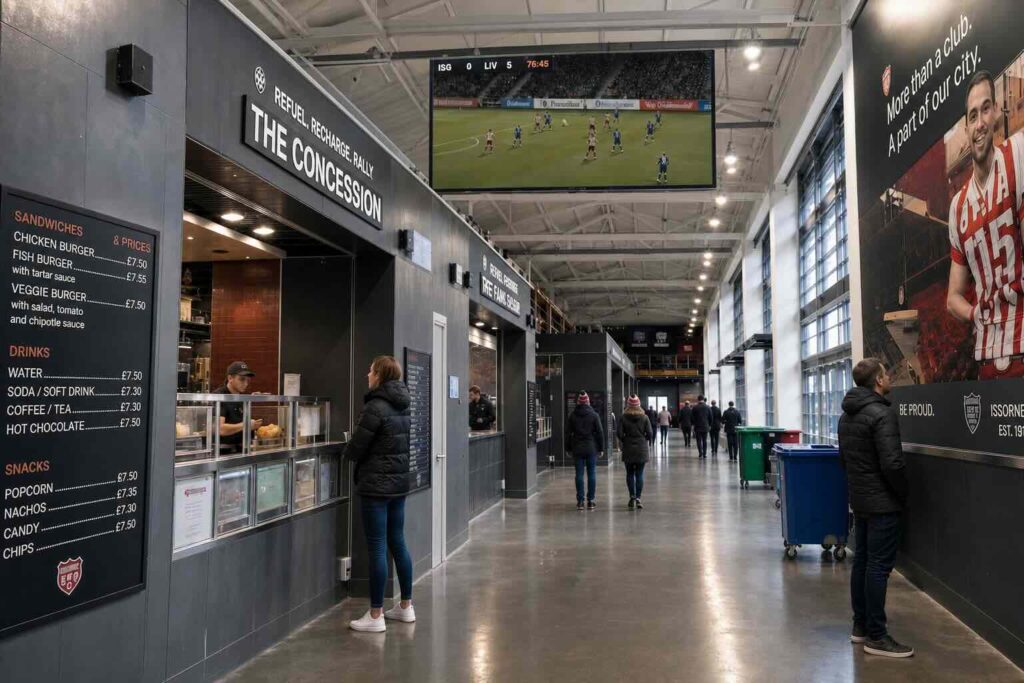
Screens That Support the Stadium Experience
In a stadium, signage is not decoration. It is commercial infrastructure, operational control, and fan communication working through the same system.
Few environments place such intense demands on information. Thousands of people arrive in a compressed window. They need to find entrances, seats, bars, toilets, merchandise stands, hospitality suites, fan zones and exits. Operators need to keep people moving. Commercial teams need to give sponsors visibility. Retail and catering teams need to put offers in front of people at the point – at the right time and place.
That is the role digital signage can play when it is designed properly.
It is not simply a screen on a wall. In stadia, a signage network becomes part of how the venue communicates, sells, directs, and responds.
The Stadium as a live environment
The scale makes the case clear. According to the Premier League’s 2024/25 annual report, average match attendance reached 40,459. That is not just a large audience. It is a large audience moving through a complex building, often at the same time, with limited patience and a strong expectation that the experience should feel organised.
Good signage starts with movement.
The Sports Grounds Safety Authority notes that information signage is essential for movement to, around and from a stadium. It also highlights the role of clear directional signage in reducing pressure on stewards and helping crowds distribute more evenly across key areas.
That is the operational value in plain terms. If people know where to go, they move better. If they move better, queues reduce, staff spend less time parroting answers to questions, and pressure points around entrances, concourses and exits become easier to manage.
Why static signage is no longer enough
Static signage will always have a role. Entrances, exits, safety messages, and permanent facilities need fixed information that is clear, compliant, and easy to understand. But stadiums are not fixed experiences.
Fixtures change. Kick-off times change. Hospitality arrangements change. Sponsors change. Concert layouts change. Weather changes. Travel information changes. Queue pressure changes. And importantly, prices and offers change.
Digital signage gives operators a way to respond.
A concourse screen can promote a quieter bar, direct supporters towards a different exit, show live travel updates after the final whistle, support safety messaging, promote a retail offer before half-time, or switch from matchday content to concert messaging for the next event.
The same screen estate can support operations, safety, retail, sponsorship and fan experience depending on the moment.
Turning Attention into Commercial Value
That flexibility is also where the commercial value becomes more interesting. For sponsors, digital signage creates media inventory across the venue. A partner is no longer limited to fixed boards, printed banners or one-off placements. Content can be scheduled by zone, event, audience, time of day or commercial priority.
A sponsor message near a turnstile does a different job from one beside a bar. A screen in a hospitality lounge has a different value from a display in a general concourse. A message shown before kick-off carries a different opportunity from one shown during half-time.
Digital signage allows that context to be managed.
The same principle applies to food, drink and merchandise. The best time to promote a product is when the customer is close enough to act. A digital menu board, offer screen or concourse display can make the decision easier: today’s special, a shorter queue nearby, a bundled food and drink offer, a merchandise reminder, a future fixture, a hospitality upgrade.
None of this needs to feel aggressive. In fact, the best stadium signage rarely does. It is useful first. It helps people make quick decisions in a busy environment. The commercial return comes from relevance, placement and timing.
The Screen is only the visible part
The screen, however, is only the visible part of the system.
A stadium does not need a collection of disconnected displays with different content standards, different control points and inconsistent reliability. It needs a signage network: displays specified for the environment, correct brightness levels, sensible mounting, robust media players or integrated software, reliable connectivity, central content management, monitoring and support.
Without that foundation, the system becomes hard to trust. Screens go blank. Old content remains live. Staff lose confidence. Commercial campaigns become harder to manage. The venue ends up with digital wallpaper rather than a working communications asset.
This is where the design of the wider infrastructure matters.
Digital signage touches the network. It touches AV. It touches content management. It touches operational support. It touches the commercial team, facilities team, IT team, safety team and front-of-house staff. Treating it as a standalone screen purchase misses the point.
Where airwave connect fits
airwave connect designs, installs and supports connected technology across AV, display, media and network infrastructure. In stadia and large venues, that means thinking beyond the screen itself and looking at how signage supports the building in use: concourse displays, fan zones, hospitality suites, retail areas, food and drink points, entrances, exits and event spaces.
For buyers, the investment case is strongest when signage is viewed across three outcomes:
First, better movement. Clearer wayfinding, faster updates and more visible information reduce friction across the venue.
Second, stronger commercial return. Screens create flexible sponsor inventory and place retail, food, drink and event promotions in the path of live demand.
Third, easier control. A centrally managed signage system allows teams to update content quickly, maintain consistency and support different event formats without rebuilding the venue every time.
A System that helps the venue perform
The modern stadium has to work harder than ever. It is a sports venue, media environment, retail space, hospitality destination, safety-critical public setting and brand platform all at once.
Digital signage sits at the centre of that mix.
Installed properly, it does not just make the venue look more modern. It helps the stadium perform: moving people more clearly, selling more intelligently, supporting staff more effectively and giving sponsors a more valuable place in the matchday experience.
Ready to make more of your stadium screens?
Digital signage can do more than display content. Used well, it can help guide fans, support matchday operations, promote services and create new commercial opportunities across the venue:
connect@airwaveconnect.co.uk or +44 (0)1403 783 483
Related Articles
Screens That Support the Stadium Experience
In a stadium, signage is not decoration. It is commercial infrastructure, operational control, and fan communication working through the same system.
Few environments place such intense demands on information. Thousands of people arrive in a compressed window. They need to find entrances, seats, bars, toilets, merchandise stands, hospitality suites, fan zones and exits. Operators need to keep people moving. Commercial teams need to give sponsors visibility. Retail and catering teams need to put offers in front of people at the point – at the right time and place.
That is the role digital signage can play when it is designed properly.
It is not simply a screen on a wall. In stadia, a signage network becomes part of how the venue communicates, sells, directs, and responds.
The Stadium as a live environment
The scale makes the case clear. According to the Premier League’s 2024/25 annual report, average match attendance reached 40,459. That is not just a large audience. It is a large audience moving through a complex building, often at the same time, with limited patience and a strong expectation that the experience should feel organised.
Good signage starts with movement.
The Sports Grounds Safety Authority notes that information signage is essential for movement to, around and from a stadium. It also highlights the role of clear directional signage in reducing pressure on stewards and helping crowds distribute more evenly across key areas.
That is the operational value in plain terms. If people know where to go, they move better. If they move better, queues reduce, staff spend less time parroting answers to questions, and pressure points around entrances, concourses and exits become easier to manage.
Why static signage is no longer enough
Static signage will always have a role. Entrances, exits, safety messages, and permanent facilities need fixed information that is clear, compliant, and easy to understand. But stadiums are not fixed experiences.
Fixtures change. Kick-off times change. Hospitality arrangements change. Sponsors change. Concert layouts change. Weather changes. Travel information changes. Queue pressure changes. And importantly, prices and offers change.
Digital signage gives operators a way to respond.
A concourse screen can promote a quieter bar, direct supporters towards a different exit, show live travel updates after the final whistle, support safety messaging, promote a retail offer before half-time, or switch from matchday content to concert messaging for the next event.
The same screen estate can support operations, safety, retail, sponsorship and fan experience depending on the moment.
Turning Attention into Commercial Value
That flexibility is also where the commercial value becomes more interesting. For sponsors, digital signage creates media inventory across the venue. A partner is no longer limited to fixed boards, printed banners or one-off placements. Content can be scheduled by zone, event, audience, time of day or commercial priority.
A sponsor message near a turnstile does a different job from one beside a bar. A screen in a hospitality lounge has a different value from a display in a general concourse. A message shown before kick-off carries a different opportunity from one shown during half-time.
Digital signage allows that context to be managed.
The same principle applies to food, drink and merchandise. The best time to promote a product is when the customer is close enough to act. A digital menu board, offer screen or concourse display can make the decision easier: today’s special, a shorter queue nearby, a bundled food and drink offer, a merchandise reminder, a future fixture, a hospitality upgrade.
None of this needs to feel aggressive. In fact, the best stadium signage rarely does. It is useful first. It helps people make quick decisions in a busy environment. The commercial return comes from relevance, placement and timing.
The Screen is only the visible part
The screen, however, is only the visible part of the system.
A stadium does not need a collection of disconnected displays with different content standards, different control points and inconsistent reliability. It needs a signage network: displays specified for the environment, correct brightness levels, sensible mounting, robust media players or integrated software, reliable connectivity, central content management, monitoring and support.
Without that foundation, the system becomes hard to trust. Screens go blank. Old content remains live. Staff lose confidence. Commercial campaigns become harder to manage. The venue ends up with digital wallpaper rather than a working communications asset.
This is where the design of the wider infrastructure matters.
Digital signage touches the network. It touches AV. It touches content management. It touches operational support. It touches the commercial team, facilities team, IT team, safety team and front-of-house staff. Treating it as a standalone screen purchase misses the point.
Where airwave connect Fits
airwave connect designs, installs and supports connected technology across AV, display, media and network infrastructure. In stadia and large venues, that means thinking beyond the screen itself and looking at how signage supports the building in use: concourse displays, fan zones, hospitality suites, retail areas, food and drink points, entrances, exits and event spaces.
For buyers, the investment case is strongest when signage is viewed across three outcomes:
First, better movement. Clearer wayfinding, faster updates and more visible information reduce friction across the venue.
Second, stronger commercial return. Screens create flexible sponsor inventory and place retail, food, drink and event promotions in the path of live demand.
Third, easier control. A centrally managed signage system allows teams to update content quickly, maintain consistency and support different event formats without rebuilding the venue every time.
A System that helps the venue perform
The modern stadium has to work harder than ever. It is a sports venue, media environment, retail space, hospitality destination, safety-critical public setting and brand platform all at once.
Digital signage sits at the centre of that mix.
Installed properly, it does not just make the venue look more modern. It helps the stadium perform: moving people more clearly, selling more intelligently, supporting staff more effectively and giving sponsors a more valuable place in the matchday experience.
Ready to make more of your stadium screens?
Digital signage can do more than display content. Used well, it can help guide fans, support matchday operations, promote services and create new commercial opportunities across the venue:
connect@airwaveconnect.co.uk or +44 (0)1403 783 483